

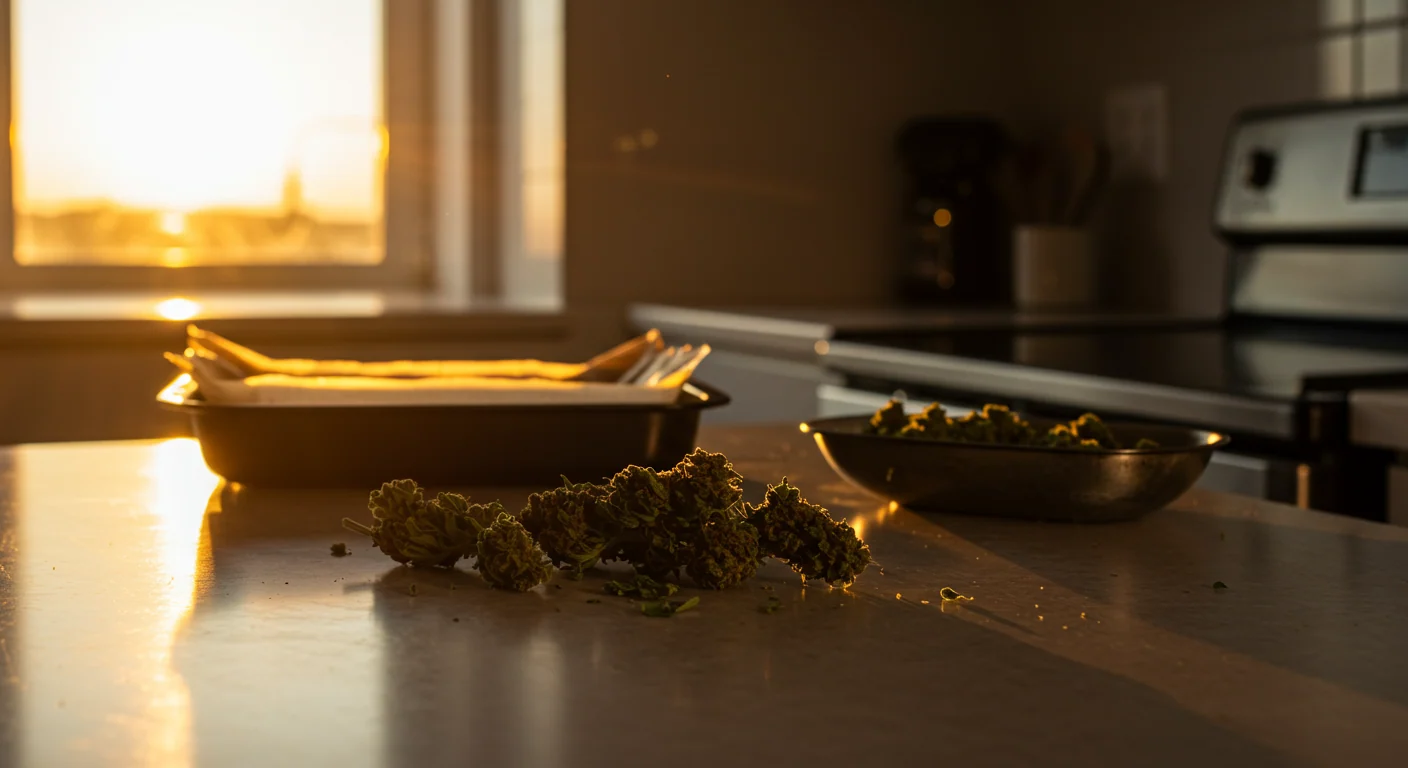
Translating raw cannabis flower into predictable culinary infusions requires understanding two distinct biochemical bottlenecks: thermal decarboxylation kinetics and lipid absorption efficiency.
For decades, home herbal extraction and culinary infusion were treated more like culinary folklore than exact biochemical science. Enthusiasts would toss arbitrary weights of cannabis flower into baking sheets or slow cookers with blocks of butter, hoping for a pleasant outcome. Inevitably, the results ranged from completely inactive batches to unpleasantly intense experiences where a single cookie delivered three times the expected psychoactive threshold.
The root cause of this unpredictability is mathematical. Raw cannabis flower does not contain high amounts of active delta-9-tetrahydrocannabinol (THC); rather, it synthesizes and stores cannabinoid acids—predominantly tetrahydrocannabinolic acid (THCA). Translating raw plant material into precise, predictable culinary infusions requires understanding two distinct biochemical bottlenecks: thermal decarboxylation kinetics and lipid absorption efficiency.
1. Decarboxylation Kinetics: The 0.877 Molecular Conversion Ratio
In its native form on the living plant, THCA possesses an additional carboxyl carboxylate group (-COOH) attached to its benzene ring. In this acidic state, the molecule is too bulky to fit comfortably into the CB1 receptors of the human endocannabinoid system, producing negligible psychoactive effects.
To convert THCA into bioactive THC, heat must be applied over time to cleave the carboxyl group, which is released as carbon dioxide (CO2) and water vapor. Because the carboxyl group accounts for roughly 12.3% of the THCA molecule’s total mass, the maximum theoretical yield of THC from THCA is governed by their molecular weights:
Maximum THC = THCA (grams) × 0.877
If an extractor starts with 10 grams of dried botanical flower testing at 20% THCA, the raw material contains 2,000 mg of THCA. Under perfect laboratory decarboxylation, that yields exactly 1,754 mg of active THC—never 2,000 mg. Furthermore, home ovens suffer from thermal cycling swings of ±15°C, meaning typical kitchen decarboxylation achieves an efficiency between 75% and 85% before thermal degradation into cannabinol (CBN) begins.
2. Lipid Carrier Efficiency and Extraction Physics
Once decarboxylated, cannabinoids must be dissolved into a fat-soluble medium. Cannabinoids are intensely hydrophobic molecules that bind preferentially to medium-chain and long-chain saturated fatty acids.
However, different culinary lipids exhibit drastically different solvent capacities:
- MCT Oil / Clarified Coconut Oil: Delivers the highest culinary extraction efficiency (typically 75% to 85%), as its dense medium-chain triglyceride profile binds rapidly with lipophilic cannabinoid structures.
- Grass-Fed Butter: Yields between 60% and 70% efficiency, primarily because unclarified butter contains roughly 16% to 18% water and milk solids that inhibit direct lipid binding.
- Extra Virgin Olive Oil: Offers approximately 65% to 75% recovery, providing high stability and monounsaturated fat benefits for savory cooking.
Crucially, plant material retains an unavoidable fraction of infused oil within its cellular matrix even after mechanical straining and cheesecloth pressing, resulting in a predictable 15% to 25% physical retention loss.
3. Calculating Final Milligram Dosing per Serving
To eliminate kitchen guesswork and ensure predictable wellness outcomes, culinary extractors can utilize dedicated computational tools such as this interactive THC potency calculator. By tracking flower mass, lab-tested cannabinoid percentages, thermal efficiency, carrier volume, and final serving counts, extractors can pinpoint the exact active milligrams delivered in each portion.
The comprehensive formula for calculating active edible potency is expressed as follows:
Active THC per Serving (mg) = [Flower Weight (g) × 1000 × (THC% / 100) × 0.877 × Decarb Efficiency × Infusion Efficiency] / Total Servings
For example, if you infuse 7 grams of 18% THCA flower into 100 ml of clarified coconut oil at an 80% decarb rate and 75% lipid transfer rate, you generate roughly 663 mg of bioavailable THC in the entire batch. Dividing that batch across 24 standardized baked goods yields 27.6 mg of active THC per serving—a precise, reproducible figure.
4. Harm Reduction and Standardized Dosing Tiers
Public health authorities and clinical herbalists classify oral cannabinoid consumption into distinct tolerance categories:
- Microdose (1 to 2.5 mg): Perceptually subtle; ideal for daytime cognitive focus and stress modulation without motor impairment.
- Standard Therapeutic Dose (5 to 10 mg): Suitable for moderate pain relief, relaxation, and mild euphoria; the benchmark recommendation for occasional adult consumers.
- High Potency (15 to 30 mg): Recommended primarily for experienced consumers and patients with established metabolic tolerance.
Because orally ingested cannabinoids undergo first-pass hepatic metabolism—converting delta-9-THC into 11-hydroxy-THC, a metabolite known to cross the blood-brain barrier with greater speed and subjective potency—precision dosing is essential.
For complete formulation worksheets, infusion temperature matrices, and inverse dosing calculators where you input your desired target milligram dose to determine required raw flower quantities, consult the open-access cannabis & herb calculator suite.
